
Authored by Kayla Stafford
For decades, neuroscientists have theorized the hippocampal CA3 region to play a central role in learning and memory through pattern completion. In this framework, fragments of stored patterns trigger the recall of complete memory representations through dense recurrent excitation among pyramidal neurons. This idea underlies many influential models of hippocampal memory and sequence replay.
These models rely on a specific architectural assumption. CA3 pyramidal neurons must form a strongly recurrent, autoassociative network, with sufficient connectivity to sustain attractor-like dynamics. While theory treated this assumption as foundational for decades, direct empirical support at the synaptic level has remained incomplete, leaving a gap between model and measurement.
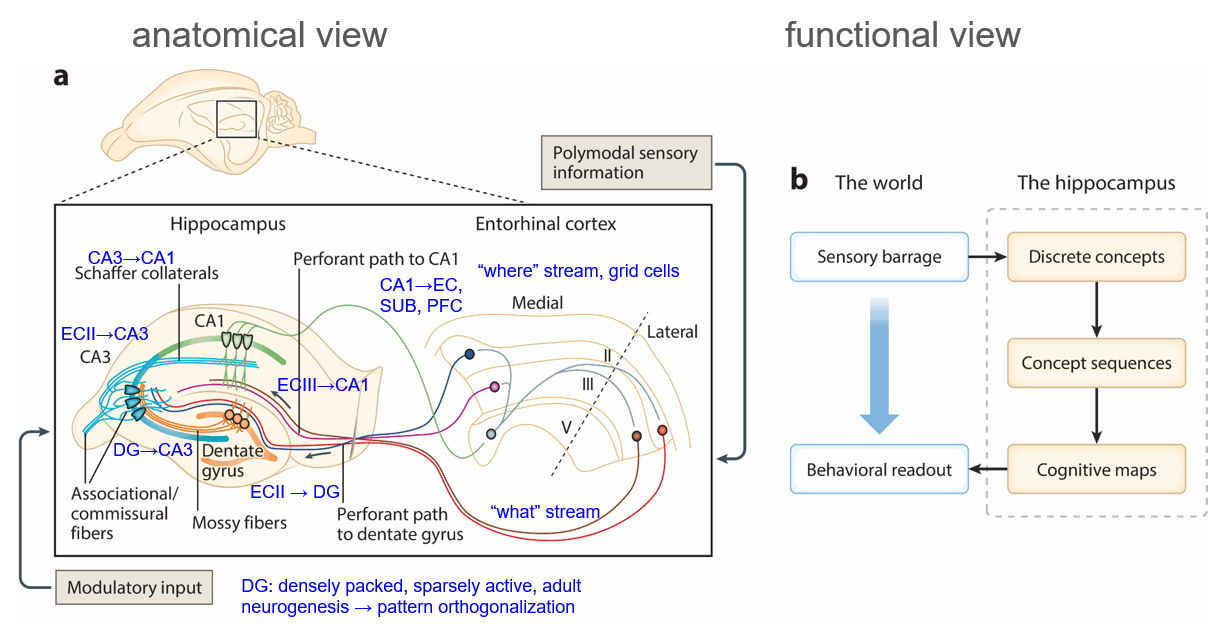
In 2016, a study by Guzman et al. challenged the prevailing view. Using paired recordings in mouse hippocampal slices, the authors reported pyramidal-to-pyramidal connectivity rates below one percent. They proposed that pattern completion might rely less on dense recurrence and more on specific higher-order motifs embedded within an otherwise sparse network.
A recent paper by Sammons et al. (2024) directly revisits this question using a dual experimental approach. The authors combine automated tape-collecting ultramicrotome and multiple-beam scanning three dimensional electron microscopy (ATUM-multiSEM) with multipatch electrophysiology recordings. Their structural dataset spans approximately 965 x 808 x 62 μm³ at nanometer resolution and includes reconstruction of axonal arbors with 1,062 identified outgoing synapses. Within 50 μm of a presynaptic soma, they measure a local pyramidal-to-pyramidal connection probability of roughly 11.2%, with connectivity declining to approximately 5.5% within 250 μm. These values exceed Guzman et al.’s estimates by more than an order of magnitude.
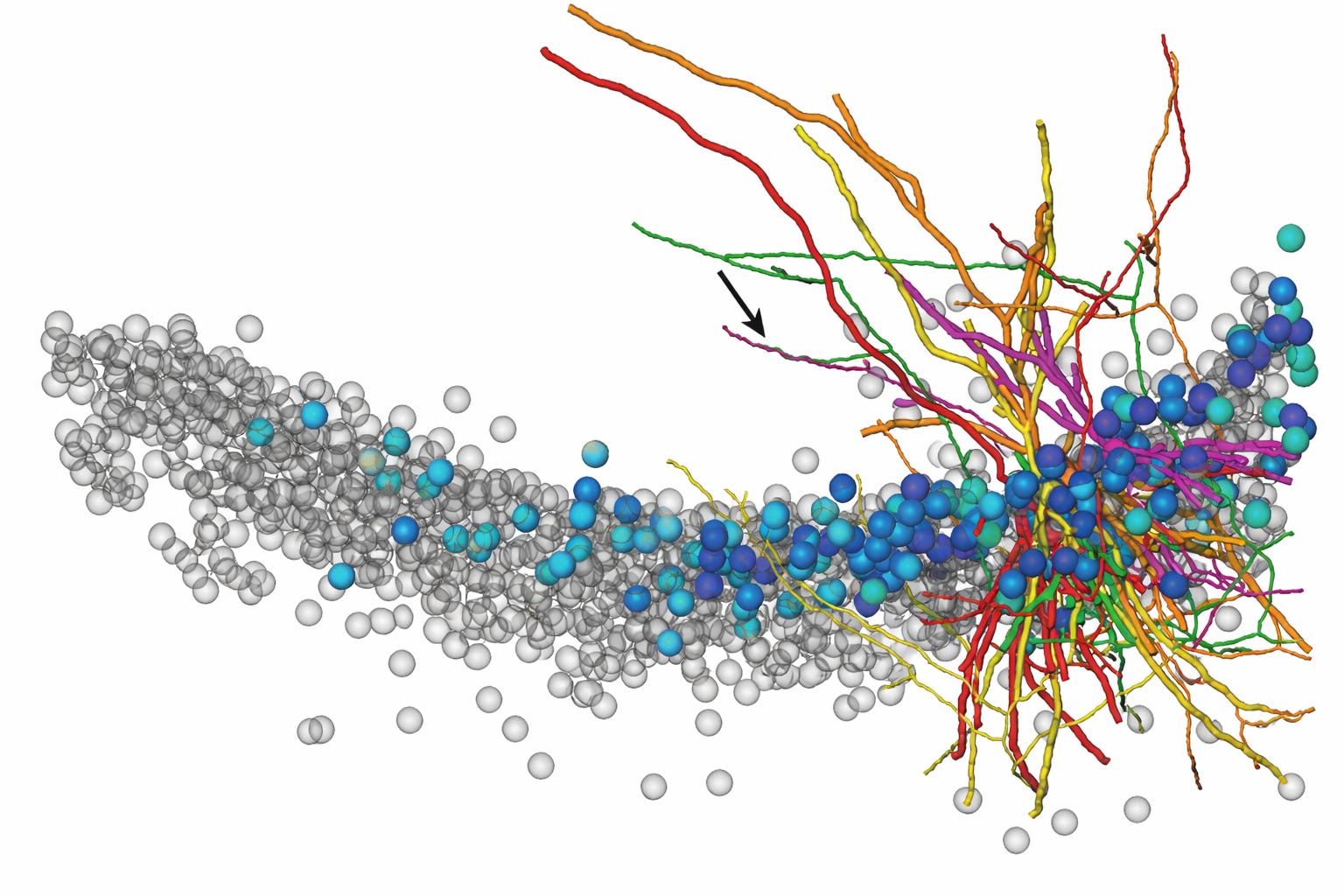
Electrophysiological measurements independently support this estimate. By recording simultaneously from up to eight CA3 pyramidal neurons, the authors test many potential connections in parallel. They evoke presynaptic spikes and measure postsynaptic responses across tested pairs, finding functional connectivity near 8.8%. Short EPSP onset latencies around 1.2 milliseconds support direct monosynaptic coupling rather than indirect network effects.
Together, these results matter for memory theory because they resolve an uncertainty that had begun to undermine decades of modeling work. Dense local recurrence in CA3 now appears as a measured biological property of the circuit, establishing CA3 as a plausible physical substrate for autoassociative memory, pattern completion, and engram reactivation rather than a theoretical convenience. With this empirical baseline restored, classic models regain plausibility without requiring specialized wiring motifs.
In our Memory Decoding Journal Club, we approached this result with a different objective. Rather than asking whether CA3 circuitry provides a viable substrate for memory in principle, we ask whether a given result brings us closer to decoding a specific memory or engram from synaptic connectivity alone.
The Memory Decoding Challenge poses a strict question: can one recover the content of a learned memory from a static map of synaptic connectivity? That criterion demands more than demonstration of circuit capacity or identification of a plausible substrate. It requires identifiable memory-specific structure and a principled mapping from connectivity patterns to memory content.
The CA3 study does not attempt such a mapping. The authors measure how densely neurons connect, not which connections encode particular experiences. Their modeling explores whether the observed connectivity can support pattern completion and replay, not whether one could infer stored memories from the wiring itself. Their work constrains what CA3 circuits could support, but it does not provide a method for reading any particular memory out of the connectome.
The schematic below makes this distinction concrete. Behavioural experiments define what an animal learns, and functional recordings reveal which neurons participate in that learning over time. Connectomic data capture synaptic structure at a single moment and constrain what a circuit could support without revealing memory content.
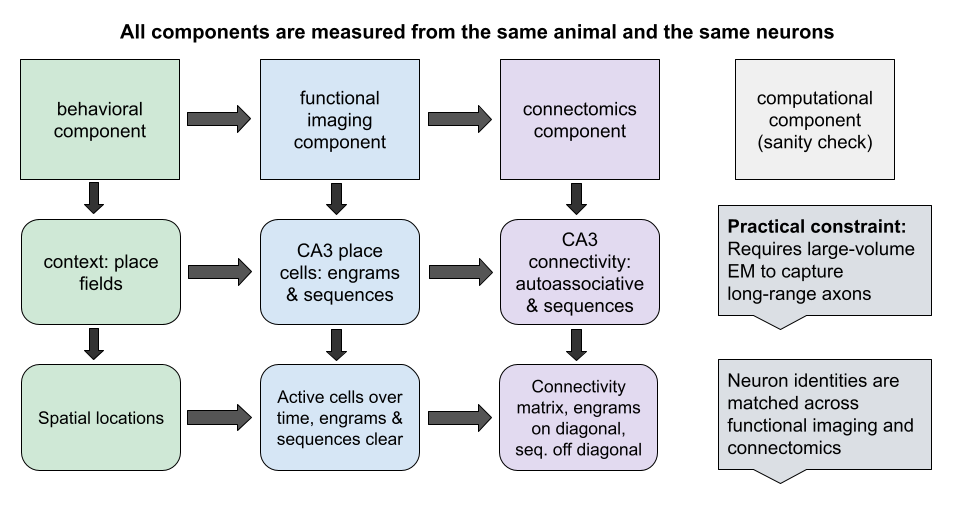
This gap clarifies what the Memory Decoding Prize asks of the field. The prize does not reward stronger evidence for plausibility or substrate identification alone. It rewards demonstrations that treat synaptic connectivity as a data structure from which memory content can emerge through decoding.
What result would convince you that a static connectome contains enough information to decode a non-trivial memory? Do you expect a successful memory decoding within the next decade? Share your thoughts in the comments.
Glossary
3D Electron Microscopy (3D-EM): A high-resolution imaging technique that reconstructs neural circuits by visualizing synaptic contacts in three dimensions at the nanometer scale.
Hippocampus: A brain structure critical for learning and memory, particularly involved in forming, organizing, and retrieving memories.
CA3 region: A subregion of the hippocampus composed mainly of pyramidal neurons, known for its dense recurrent excitatory connectivity and hypothesized to support pattern completion and memory recall.
Autoassociative network: A network architecture in which recurrent neural connectivity allows partial activation of part of the network to trigger the recall of the entire stored pattern or memory.
Pyramidal neurons: Excitatory principal cells in the hippocampus characterized by a pyramid-shaped cell body and long apical dendrites; they form the core of the CA3 network.
Static connectome: A map of synaptic connections captured at a single time point, without accompanying activity measurement.
Engram: A population of neurons and synapses whose activity and connectivity participate in the storage and recall of a specific learned memory.
Resources and Links
Main paper discussed
Sammons et al. (2024), Structure and function of the hippocampal CA3 module, PNAS https://www.pnas.org/doi/10.1073/pnas.2312281120
Prior study motivating the connectivity debate
Guzman et al. (2016), Synaptic mechanisms of pattern completion in the hippocampal CA3 network, Science
https://www.science.org/doi/10.1126/science.aaf1836
Join the Memory Decoding Journal Club mailing list
Join the Journal Club at Aspirational Neuroscience: https://aspirationalneuroscience.org/register-with-us/
Memory Decoding Journal Club discussion (January 27, 2026)
Watch the full video recording here: