

Authored by Nippani Meghana
Today’s AI can solve complex mathematical problems, write essays, generate code and engage in conversations that seem almost human. At the same time, these same systems struggle with maintaining coherent context over long interactions, adapting themselves to unfamiliar and different situations, and applying cross-domain knowledge – tasks that humans find trivial. The distance between what today’s AI can do and what humans do effortlessly is what researchers are trying to close – and that effort has a name, Artificial General Intelligence (AGI).
Why Defining AGI Is Difficult
The term AGI is often used in research papers, technology news, and online forum discussions. Depending on who you ask, the answer changes: for some it’s already here, and for others it is decades away. The problem is that the current field is highly fragmented, and there exists no universally accepted definition of AGI. To some people, AGI refers to a system capable of making decisions and taking actions that produce economic value and performing tasks that a human can perform. For others, it refers to a system that can learn, adapt, and transfer knowledge across domains and a broad range of environments. Regardless of the definition, the central idea revolves around exhibiting intelligence in a broad context and generalizing knowledge. Beyond semantics, AGI requires defining human intelligence, and that question has been contested for years.
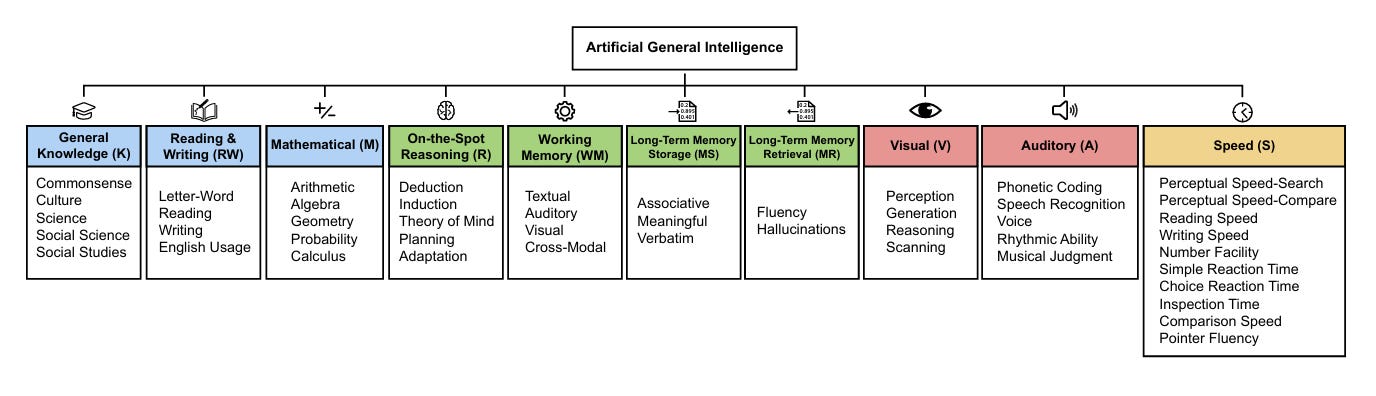
In A Definition of AGI, the authors explain the framework for AGI with respect to the most empirically validated model of human cognition, Cattell-Horn-Carroll theory. They state that AIs can perform some tasks exceptionally well, distorting the view of how human intelligence is perceived. Human memory is not perfect, but it is rarely arbitrary. What we remember is shaped by emotional salience and attention (by LaBar KS et al.,). Many current AI systems, by contrast, still depend heavily on what is present in the immediate prompt or retrieved from external memory systems, making their memory less persistent and less integrated than human cognition. This is one of the examples of failure in demonstrating an even cognitive profile. The image attached below shows the defining features of AGI as per the CHC framework.
The jagged cognitive profile goes beyond memory as humans often rely on multiple cognitive abilities at the same time to perform a task, the cognitive abilities are interdependent. When you are having a conversation, you’re simultaneously retrieving context, reading emotional cues, and applying cultural knowledge. Current AI systems can retrieve facts about culture without understanding how cultural context shapes meaning because that requires integrating multiple cognitive abilities at once, something the jagged profile prevents. The jagged profile in LLMs like GPT-4 and GPT-5 can be seen below, based on Hendrycks et al.'s own scoring methodology, which weights all ten cognitive domains equally.
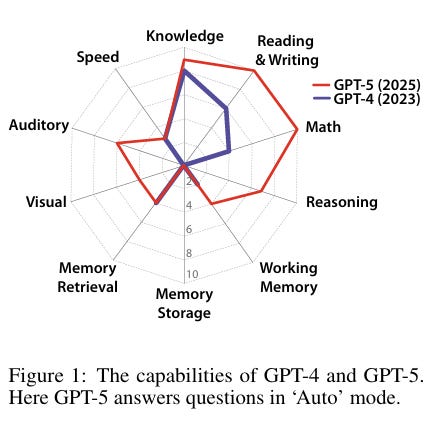
The unevenness is visible even across model generations, GPT-5 outperforms GPT-4 in knowledge and math, but both remain weak in memory storage and retrieval.
Despite rapid improvements in frontier models, evaluating progress toward AGI remains challenging because advances in individual capabilities do not necessarily imply uniformly general intelligence. But even a framework this rigorous still measures AI against a single, fixed idea of ‘human-level’ performance and that target itself turns out to be far less fixed than it sounds.
Why “Human-Level” Isn’t a Finish Line
Humans differ from one another, and so does human intelligence. Human intelligence emerges from the complex interaction of cultural, biological, environmental, and developmental factors. One person can excel at reasoning while also struggling with working memory; another may demonstrate exceptional memory but perform less well in problem solving.
Despite the complexity of human cognition, humans remain the only known example of general intelligence. Every current definition of AGI, whether it emphasizes economic value, generality, or cognitive abilities, ultimately derives its benchmark from human performance. Human intelligence is therefore not used because it is perfectly understood or uniform, but because it is the most extensively studied example of a system capable of learning, reasoning, adapting, and transferring knowledge across diverse environments.
The multidimensionality of human intelligence changes the conversation. Instead of debating whether this system is AGI or not, a more useful set of questions can be: What are the requirements for general intelligence? Where do current systems sit? And which cognitive abilities remain underdeveloped?
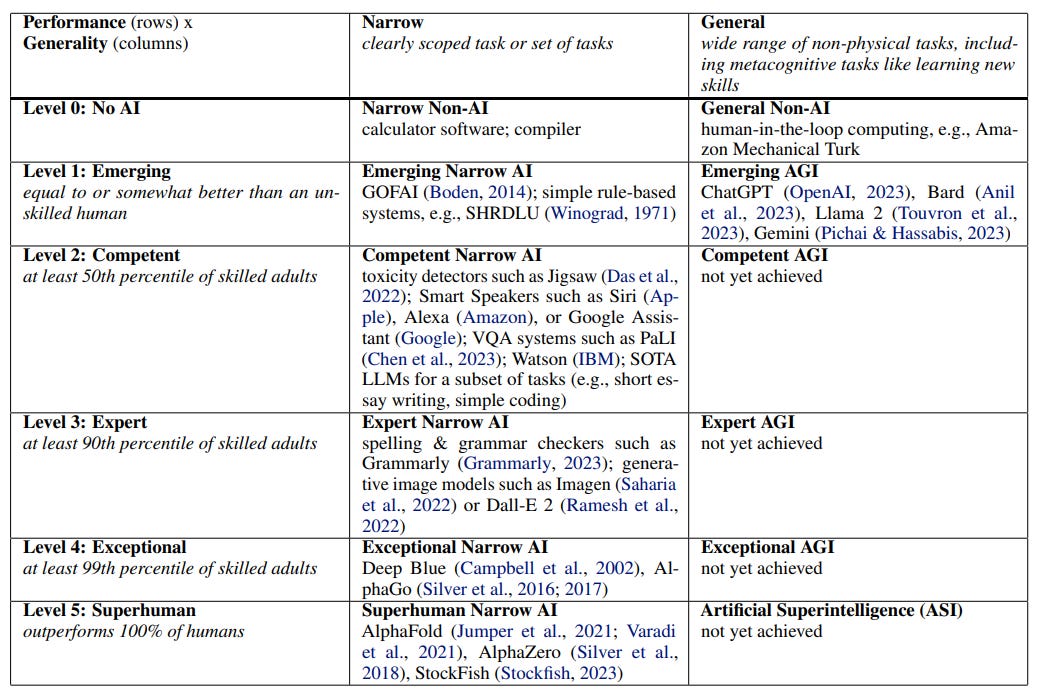
Defining those requirements is not straightforward. Systems should be classified not only by how well they perform individual tasks but also by the breadth of tasks they can perform. For example, Google’s AlphaFold can’t be considered a general intelligent system, as it performs exceptionally well with respect to protein structures but it is not capable of carrying out a broader range of cognitive tasks. The same is true of a system that can beat humans at chess. These systems are considered narrow; they perform extraordinarily in one aspect and are weak in the other. If the goal is to have a system that can perform mathematical calculations, write codes but also expand its abilities to metacognition, then we need generalized models. A simple binary distinction between “AGI” and “not AGI” provides little guidance for scientific progress. Researchers need ways to continuously evaluate capabilities, identify remaining gaps, and assess how increasingly general systems evolve over time.
In 2023, Google DeepMind scientists formalised this into levels of AGI. Each level corresponds to human performance across tasks. The system’s capabilities should be applicable across a broad range of tasks and extend to metacognitive tasks and learning under new paradigms. The authors stated that the focus should be on the capabilities and not on the internal mechanism. In this way, progress can be measured through increasingly capable systems, allowing researchers to identify gaps, establish meaningful benchmarks, and continuously evaluate risks, capabilities, and ethical considerations that may arise along the way. The table below by Morris et al., shows how progress is tracked and where current systems fall on that spectrum.
Why Definitions Matter
The definition is not merely an academic problem. What AGI means determines what you build, how you measure progress, define goals and the risks that need to be considered. A lab that prioritises economic value will produce a machine that is quite different from the one that prioritises a close resemblance to general human cognition. The differences go beyond philosophical arguments, they involve different assumptions. Two research directions with different definitions of AGI are, in a meaningful sense, building toward different but convergent futures. A system built to maximize task performance can be evaluated mostly through its outputs whereas if the goal is to have human-like cognition, then it raises questions about ethics, accountability and mechanism. The question, then, is not only what AGI is, but how researchers pursue a goal whose definition remains unsettled.
Where We Go From Here
This is Part 1 of The Brain & The Machine, a series on AGI, whole brain emulation, and the relationship between them. If this article asked what we mean by AGI, the next one asks how AGI might actually be approached. We’ll look at two broad paths: one that tries to engineer intelligence directly, and another that treats the human brain as the only known example of general intelligence and asks what it would mean to emulate it.
References:
Hendrycks, D., Song, D., Szegedy, C., Lee, H., Gal, Y., Brynjolfsson, E., ... & Bengio, Y. (2025). A definition of AGI. arXiv preprint arXiv:2510.18212.
Morris, M. R., Sohl-Dickstein, J., Fiedel, N., Warkentin, T., Dafoe, A., Faust, A., ... & Legg, S. (2023). Levels of AGI for Operationalizing Progress on the Path to AGI. arXiv preprint arXiv:2311.02462.
LaBar KS, Cabeza R. Cognitive neuroscience of emotional memory. Nat Rev Neurosci. 2006 Jan;7(1):54-64. doi: 10.1038/nrn1825. PMID: 16371950.