Dynamic Reference Frames in the Brain’s Internal Map
How Grid Cells Navigate Without Landmarks

In a laboratory in Trondheim, Norway in 2005, neuroscientists Edvard and May-Britt Moser discovered neurons with an extraordinary property: they fired at multiple locations forming precise hexagonal grids as animals moved through space. This discovery earned them the Nobel Prize in Physiology or Medicine in 2014 and established grid cells as fundamental components of the brain's spatial navigation system. Grid cells form overlapping lattices at different scales, feeding spatial information into hippocampal place cells that encode specific locations and memories. Together, they've been called the "GPS of the brain." However, a question remained: do grid cells function as a fixed global positioning system anchored to external landmarks, or do they operate within multiple local reference frames that shift during navigation?
Navigating without landmarks requires maintaining position estimates from noisy internal signals. The process resembles drawing a straight line blindfolded in a moving car: every bump adds a wobble, and without visual feedback, tiny errors accumulate into major deviations. The brain performs precise geometry using only imperfect internal signals.
If grid cells require continuous visual recalibration, they fail in darkness. If they maintain stable representations without landmarks, they provide a true internal metric for movement.
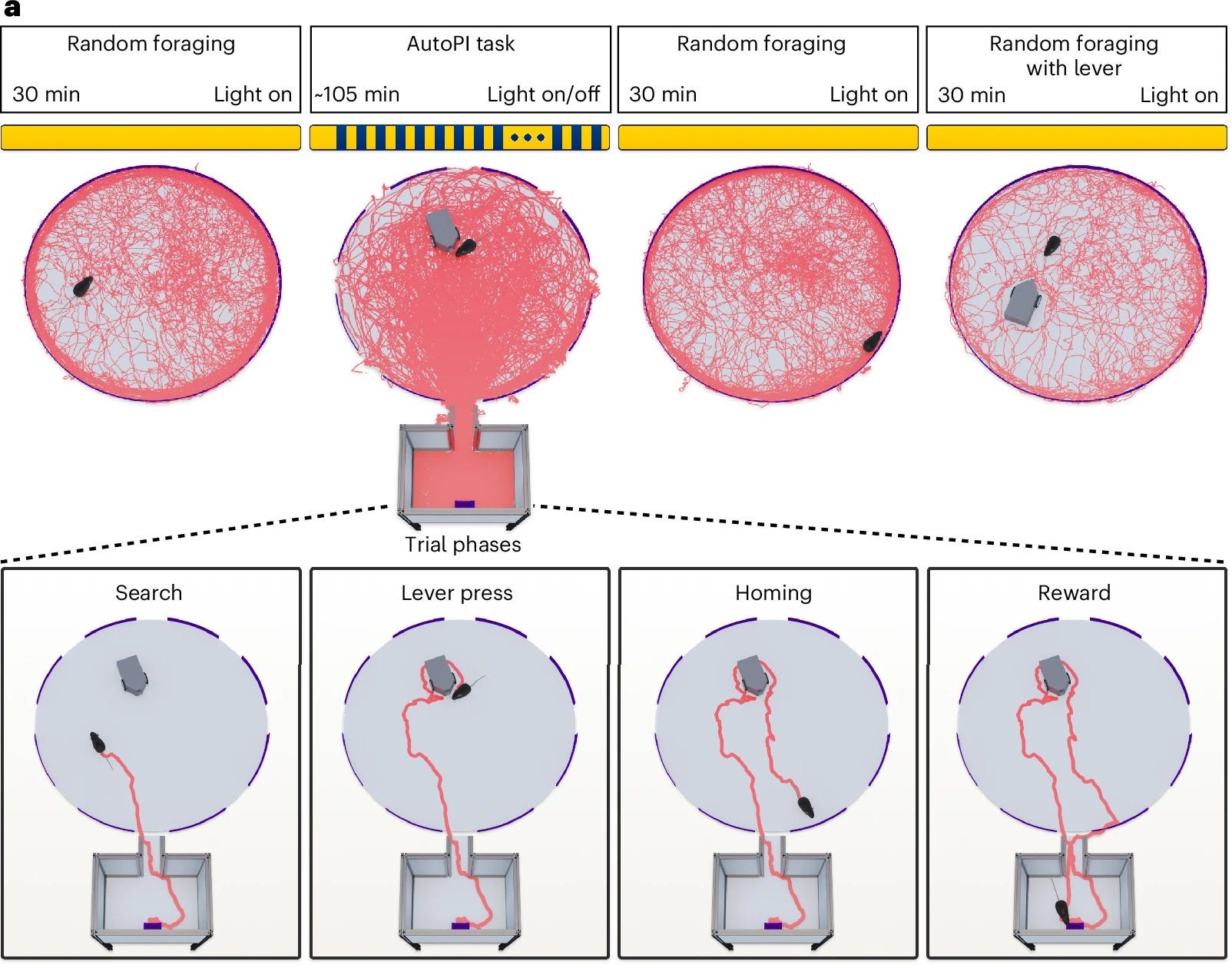
To test whether grid cells function without visual landmarks, researchers used the AutoPI task (originally developed by Jazi et al. 2023), in which mice searched a circular arena for a randomly placed lever that dispensed food when pressed (Figure 1). After pressing the lever, the mice returned home to collect the reward. Trials alternated between normal lighting and complete darkness. The lever moved every fourth trial and the arena rotated after each trial, preventing route memorization. During dark trials, the mice lacked visual landmarks and relied entirely on self-motion cues to track position. Each session began with random foraging trials in the illuminated arena to establish baseline grid cell activity before the navigation task.
Researchers recorded 5,746 medial entorhinal cortex neurons across 180 sessions and classified 931 as grid cells. In darkness, the mice took longer search paths and produced larger homing errors than in light, but still performed above chance. Homing error increased linearly with path length, matching the expected accumulation of path integration drift.
The study found that grid cells did not maintain stable, room-anchored firing patterns. Instead, their activity switched reference frames mid-trial. During search in darkness, grid cells fired at fixed room locations. After the mice reached the lever, the entire grid pattern reanchored to the lever’s location. Individual cells then fired at specific distances and directions from the lever rather than at fixed room coordinates. When the lever moved during later trials, the firing fields moved with it. Figure 2 shows this shift in spatial coding directly.
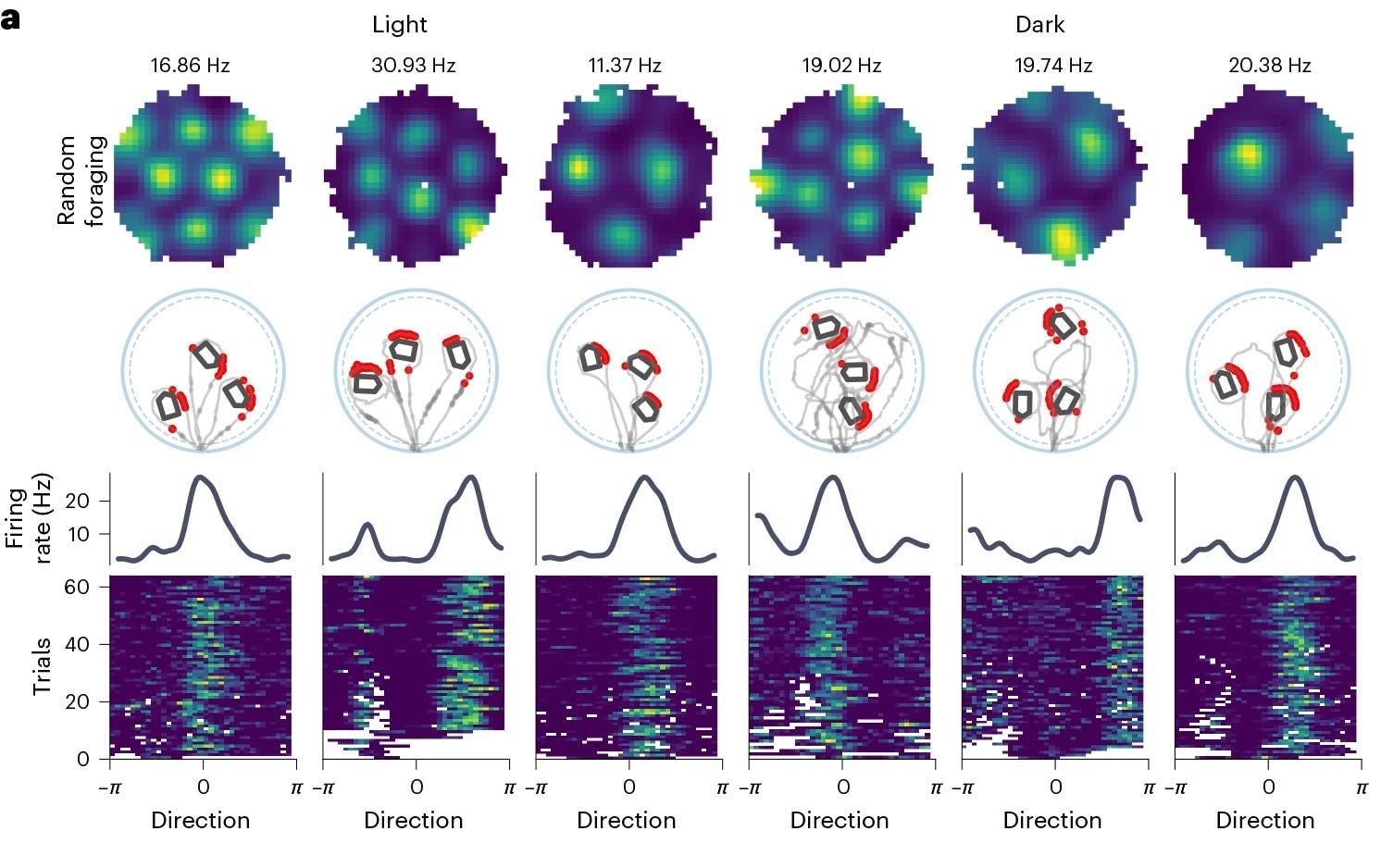
Researchers observed statistically significant reanchoring in 23 of 24 sessions. Although the grid pattern shifted its anchor point in physical space, the internal structure of the network remained preserved. Temporal firing relationships and phase offsets between cells persisted across reference frames. These results suggest that grid cells transition flexibly between global and local coordinate systems depending on behavioral context rather than sensory availability alone.
Moreover, this flexibility persisted even when visual landmarks remained available. Although the grid pattern shifted between reference frames, the relative firing relationships between cells persisted. Individual firing fields moved, but the network retained its internal organization. Grid cells maintained stable offsets and coordinated activity patterns even as the external anchor point shifted from the room to the lever.
At the population level, this organization formed what neuroscientists call a toroidal manifold: a donut-shaped representational space in which neural activity continuously wrapped around itself rather than terminating at fixed boundaries. This organization allowed the brain to track position smoothly across space without the internal map breaking at edges. Together, these dynamics resembled a continuous attractor network, a self-stabilizing system that maintained coherent spatial representations even while the network reanchored to different reference points.
Drift in grid cell orientation directly predicted behavioral homing errors, establishing a quantitative link between neural representation and navigation performance. Error accumulation within the grid cell network ultimately constrained navigational accuracy. These findings explain why path integration degrades over distance: the neural coordinate system itself drifts, not merely the behavioral output.
We recently discussed this paper during the Memory Decoding Journal Club because it highlights a central challenge in connectomics: can researchers infer neural representations from circuit structure alone? This study connects directly to the broader Memory Decoding Challenge, which asks whether scientists can reconstruct a non-trivial memory from a static map of synaptic connectivity.
The authors decoded the animal’s position from grid cell firing patterns in real time, predicted behavioral errors trial-by-trial, and linked specific patterns of grid activity to navigation performance. However, this decoding depended entirely on measuring neural activity over time. Researchers still do not know whether static wiring alone contains enough information to support the same decoding ability.
Researchers face major difficulties when attempting to infer grid cell spatial tuning from connectivity alone. The mouse medial entorhinal cortex, with a volume of only roughly 0.3–0.4 mm³, presents a plausible near-term target for dense structural reconstruction. Yet even a complete connectome of the MEC would not fully explain how grid cells generate hexagonal firing patterns with specific spacing, phase, and orientation. Spatial tuning depends not only on local synaptic connectivity, but also on broader sensorimotor circuits that provide head-direction and self-motion information across multiple brain regions. Researchers therefore confront a spectrum that ranges from identifying plausible neural substrates for computation to directly reading encoded information from circuit structure. This study advances the former goal while emphasizing the remaining gap to the latter.
The challenge grows even more difficult when episodic memory enters the discussion. Grid cells provide a metric coordinate system, while hippocampal place cells integrate context, objects, and events alongside grid cell input to form episodic representations. Decoding a specific memory from connectivity would require identifying not only which place cells participated in an experience, but also how their spatial tuning interacted with contextual information to generate a unique memory trace.
The reanchoring phenomenon introduces another complication. Although the toroidal organization of grid-cell activity remained stable across reference frames, the external reference point for that activity shifted dynamically during navigation. These findings suggest that the underlying MEC circuitry may preserve a stable internal manifold while broader sensorimotor systems determine which reference frame becomes engaged during behavior. Reconstructing these representations may therefore require identifying not only the local circuitry that maintains the toroidal structure, but also the larger networks that provide head-direction, self-motion, and contextual input across multiple brain regions.
Researchers once viewed grid cells as components of a fixed internal map of space. This study instead portrays spatial representation as a flexible and continuously shifting process that nevertheless preserves deeper network organization. Understanding how the brain maintains stable cognition within such dynamic neural systems may become central not only to navigation research, but also to future attempts at decoding thought and memory directly from neural circuits.
Glossary
Grid cells: Specialized neurons primarily (but not exclusively) located in the medial entorhinal cortex that fire at multiple spatial locations forming a periodic triangular or hexagonal grid pattern, providing a metric coordinate system for tracking position during navigation.
Path integration: brain’s mechanism for continuously updating one’s position and orientation by integrating self-motion cues (vestibular, proprioceptive) with existing spatial knowledge.
Reference frames (room-centered vs lever-centered): neural coordinate systems that anchor spatial representations to different environmental points. Grid cells transition from room-anchored coding (stable external environment) to lever-anchored coding (task-relevant target location) during path integration navigation.
Toroidal manifold: mathematical “donut-shaped” map of neural activity that allows the brain to track movement through infinite space by looping signals in continuous circles, preventing the internal map from ever hitting an “edge”.
Medial entorhinal cortex (MEC): specialized brain region in medial temporal lobe that functions in spatial navigation, memory, and path integration. Houses specialized neurons such as grid cells that create a mental map of the environment.
AutoPI task: navigation task where animals locate a target in light, then return to it in darkness, testing the ability to track position using self-motion cues without external landmarks.
Reanchoring: phenomenon where grid cells transition between world-centered and task-centered reference frames during navigation while preserving their characteristic hexagonal firing pattern and toroidal manifold structure.
Resources and Links
Join the Memory Decoding Journal Club: Aspirational Neuroscience - Join Us
Watch the full video of our Memory Decoding Journal Club discussion here (April 29, 2026):