
The Carboncopies Foundation is a nonprofit organization focused on the technical, theoretical, and ethical prerequisites for whole brain emulation (WBE). While various institutions explore specific niches of neurotechnology, Carboncopies remains the only entity addressing the end-to-end pipeline: the transition from high-resolution structural and functional data acquisition to validated, substrate-independent computational models.
Our work is categorized into three interconnected domains: Research, Community-Building, and Education.
I. Research: Addressing the Validation Bottleneck
For over a decade, our WBE Roadmap has tracked the progress of neurotechnology. We have observed a significant shift in the field’s primary bottleneck. While the acquisition of structural data was once the greatest hurdle, recent advances in high-throughput electron microscopy have produced complete connectomes for Drosophila and zebrafish, alongside substantial mammalian datasets.
As data availability has expanded, questions of model validation have become increasingly central across whole brain emulation research. In response to this broader challenge, Carboncopies has initiated several efforts aimed at developing concrete, testable evaluation frameworks. Two such efforts are:
The Brain Emulation Challenge: Progress in AI was accelerated by standardized benchmarks like ImageNet. We are applying this logic to neuroscience by generating synthetic brains with known ground-truth parameters. Researchers use these datasets to test their reconstruction methods, allowing us to quantify exactly where current analysis pipelines fail.
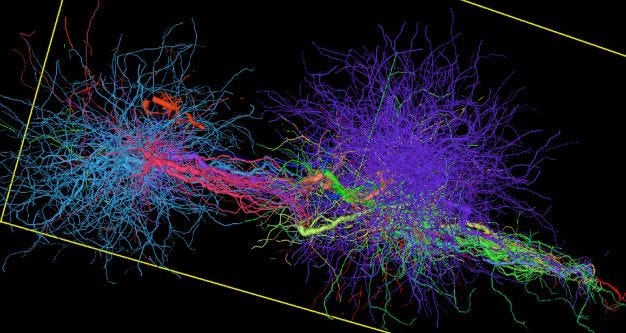
Figure 1. Snapshot from Neuroglancer displaying the detailed 3D neurite structure of a synthetic ground-truth example generated by Netmorph and BrainGenix-NES. Each neuron’s morphology is shown in a unique color for ease of inspection.
The Ethics Framework: We are developing a proactive ethical architecture that anticipates the intersection of WBE with clinical neurology. This includes rigorous analysis of informed consent in the context of neuro-prosthetics and the long-term responsibilities of researchers managing emulated systems.
II. Technical Community & Collaboration
Carboncopies functions as an international hub for nearly 100 researchers, spanning computational neuroscience, machine learning, and philosophy of mind. Our efforts center on fostering rigorous peer-to-peer exchange:
Memory Decoding Journal Club: A collaboration with the Brain Preservation Foundation’s Aspirational Neuroscience campaign. We analyze the feasibility of decoding non-trivial memories from static connectomic data. This group oversees the review process for the $100,000 grand prize for the first demonstration of memory decoding from static datasets.
Consciousness & Subjective Experience: A focused group addressing the foundational questions of identity and functionalism that arise when considering human applications of emulation.
Workshops & Symposia: We facilitate technical deep-dives into conceptual bottlenecks, frequently presenting at the Society for Neuroscience (SfN) annual meeting.
III. Global Infrastructure
Headquartered in California but operating as a distributed international organization, Carboncopies supports the next generation of researchers through university lectures, student organization support, and PhD co-mentorship.
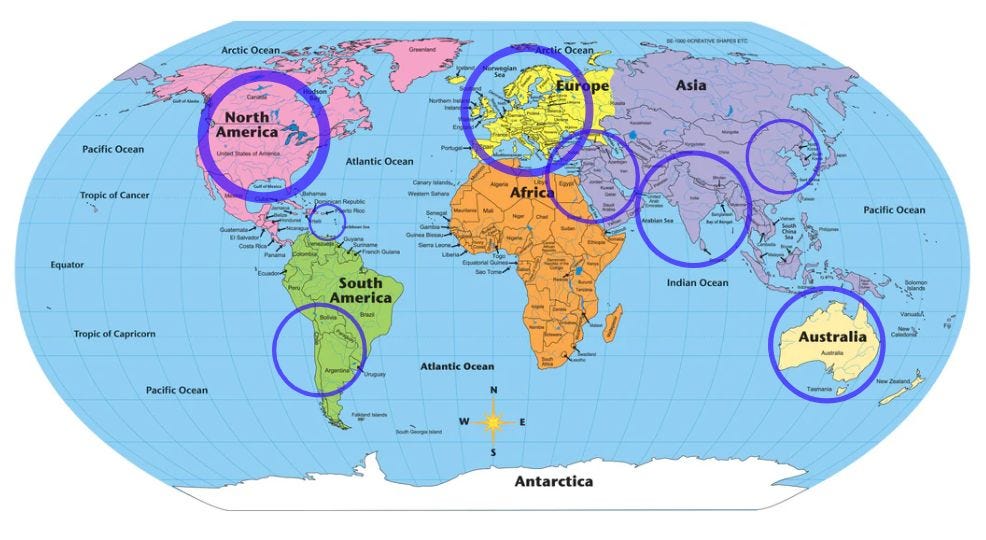
Figure 2. Geographic distribution of the Carboncopies research team. Circles highlight principal regions and line thickness gives a relative indication of the number of team members in each region.
Next Steps
This Substack will serve as a repository for our technical updates, roadmap revisions, and summaries of our Journal Club proceedings. We invite researchers, engineers, and theorists to engage with our current projects and help refine the benchmarks for successful brain reconstruction.
If you’d like to learn more about our recent work, you can also read our December 2025 newsletter.
You can also follow Carboncopies on X/Twitter, LinkedIn, and YouTube, or join the discussion on Discord.